Table of Contents
Reducing Tech Overload to Focus on Learning
The Psychology of Tech Overload: Why Our Brains Crave the Ping
Digital Productivity: Why More Apps Don’t Mean More Focus
Digital Minimalism Defined: The Philosophy of Intentional Connection
Academic Consequences of Tech Overload
“Digital Detox Loop” That Actually Works
Minimalist Tech Habits That Boost Academic Flow
Designing a Digital Identity That Supports Learning
Digital Minimalism for Students: The 30-Day Focus Reset Plan
Introduction: The Silent Struggle Behind the Screen
It’s 10 p.m. A student opens their laptop to study but before the notes even load, a notification pops up. Then another. Within minutes, they’ve checked three group chats, scrolled through updates, and convinced themselves they’re “being productive.” Yet, an hour later, the book remains untouched, and focus feels like a distant dream.
This is the silent struggle of modern students: mentally busy, but academically drained. Our brains are constantly switching between apps, alerts, and social feeds, creating the illusion of engagement while silently eroding our attention span. Each ping promises importance, but what it really delivers is fragmented focus and subtle exhaustion.
I’ve personally felt this cycle more times than I can count. I used to open my phone “just to check one thing” before studying, only to realize an hour had passed scrolling through meaningless updates. I told myself I was learning online, but in reality, I was feeding distraction disguised as productivity. That realization was the turning point it made me question how technology was shaping my mind more than my study habits were.
We live in an age of false productivity where doing more on screens feels like achieving more, even when our progress barely moves. The dopamine rush from every like, message, or update tricks the mind into feeling “connected,” while deep work and genuine learning slip further away.
But here’s the truth: digital minimalism isn’t about deleting everything or escaping technology. It’s about reclaiming control. It’s a philosophy that asks what digital habits actually serve my goals, and which ones silently steal my focus? For students chasing academic success and peace of mind, this shift in mindset is not optional anymore it’s essential.
The Psychology of Tech Overload: Why Our Brains Crave the Ping

If you’ve ever heard a notification and instantly felt the urge to check your phone, even when you knew it wasn’t important, that wasn’t lack of willpower. It was neuroscience at work.
Every ping, vibration, or red badge on your screen triggers a dopamine loop, a reward cycle that conditions the brain to seek instant stimulation. Dopamine isn’t the chemical of pleasure itself; it’s the chemical of anticipation. It makes you crave the next update, the next scroll, the next “maybe something exciting happened.” This constant loop keeps the brain in a restless state of seeking, not focusing.
For students, this creates a dangerous paradox: being busy without being productive. The mind feels active messages are being answered, tabs are open, and multitasking feels efficient but the cognitive system is quietly burning out.
How Multitasking Hijacks Focus and Memory
Neuroscientists call it context switching, and it’s one of the biggest enemies of learning. Every time you switch from your notes to WhatsApp or from a lecture video to a new YouTube tab, your brain must pause, reorient, and refocus. That reorientation costs mental energy. Research shows that multitasking can reduce working memory capacity the brain’s ability to hold and manipulate information by up to 40%.
In simpler terms, you’re not truly doing multiple things; you’re just shifting between tasks rapidly and paying a heavy focus tax each time. Over time, this constant switching trains your brain to expect distraction. Deep focus becomes uncomfortable, even boring, because your mind has been rewired for micro-rewards instead of long-term concentration.
A Real-World Student Scenario
Imagine a student trying to study for an exam. Their notes are open, but a YouTube recommendation catches their eye. “Just one video,” they think. Then a WhatsApp message pops up, followed by a quick check on Instagram. Each switch feels harmless a five-second break here, a quick reply there. But to the brain, this is chaos.
The prefrontal cortex, which handles decision-making and focus, keeps stopping and restarting its processes. The result? Surface-level learning instead of deep understanding. Even after hours “studying,” the student remembers little because their brain never entered sustained concentration.
I’ve been in that same cycle myself. Sometimes, I would study with my phone beside me and convince myself it wasn’t a distraction until I noticed I was rereading the same paragraph again and again. It wasn’t that I didn’t care; it was that my brain had been trained for constant novelty. Realizing that changed how I approached both technology and learning.
Digital overload isn’t just about time wasted it’s about mental bandwidth consumed by things that never deserved it. And recognizing this pattern is the first step toward reclaiming your focus.
The Myth of Digital Productivity: Why More Apps Don’t Mean More Focus

In the digital age, productivity has been rebranded as a kind of aesthetic. Screens filled with colorful planners, habit trackers, and synchronized dashboards promise control of a smarter, more efficient way to study. But here’s the paradox: the more tools students use to organize their learning, the less focused they often become.
What begins as an attempt to simplify learning soon morphs into a cycle of digital clutter dozens of apps, tabs, and notifications that silently compete for attention. It’s a modern trap: we mistake app activity for academic progress.
When Productivity Tools Become Distraction Loops
Students today are surrounded by digital ecosystems designed to “optimize” every minute calendar reminders, study timers, note-taking apps, and progress trackers. But each tool adds its own layer of cognitive load, the mental effort required to manage and remember what’s next.
The moment you open Notion to plan a study schedule, you’re tempted to tweak templates, pick icons, or adjust layouts — tasks that feel productive but rarely move your learning forward. What started as focus management quickly became focus fragmentation.
Psychologists call this the illusion of control when organizing feels like progress, even though it’s just rearranging the same chaos. The mind receives dopamine from “setting up,” not from actually doing. That’s how digital productivity morphs into a disguised procrastination loop.
The Hidden Exhaustion of Managing Too Many Tools
Every app you open demands a small share of mental bandwidth. You switch between note systems, update task lists, sync devices, and check metrics all of which drain cognitive energy. This constant toggling leads to tool fatigue, a condition similar to information overload but triggered by digital management itself.
When every part of your learning depends on an app, your brain no longer practices the natural skill of self-regulation. You become dependent on external triggers: a timer to start, a notification to stop, a reminder to remember. Over time, this weakens your intrinsic discipline, making study sessions feel mechanical and unsatisfying.
I once used five different apps to manage my study routine: one for notes, one for reminders, one for focus timing, one for tracking habits, and one for journaling. Ironically, I spent more time syncing them than actually studying. The day I deleted half of them, my mind felt lighter and my focus returned. That’s when I realized that simplicity fuels consistency.
Case Insight: When Tools Outnumber Intentions
Take the example of a university student juggling Notion, Google Calendar, and Pomodoro timers. On paper, it looks efficient. In practice, it’s chaos. Each app sends its own alerts, demands updates, and pulls the student into micro-tasks editing dashboards, adjusting timers, and color-coding notes.
By the end of the day, the student has “organized” everything but learned almost nothing. The issue isn’t laziness it’s digital dependency. When productivity is mediated through too many platforms, focus is split into fragments too small to sustain deep learning.
Minimal Tools, Maximum Focus
The truth is, digital minimalism isn’t anti-technology it’s pro-intention. The best productivity system is the one that disappears into the background, allowing your mind to focus on the work itself. One clean digital space, one consistent routine, and one clear goal can outperform ten fancy tools.
Because real productivity doesn’t come from managing systems it comes from managing attention.
Digital Minimalism Defined: The Philosophy of Intentional Connection

Digital minimalism isn’t about deleting your social media, tossing your phone, or escaping the internet. It’s about redefining how you relate to technology not as a master to obey, but as a tool to intentionally design your learning life around.
At its essence, digital minimalism means using technology with purpose, not impulse. It’s the art of choosing what matters, rather than letting algorithms decide it for you. For students, that means being deliberate about every platform, app, or digital habit: not how much time you spend online, but why you spend it.
The Minimalist Filter: “Does This Serve My Learning Goal — or Drain It?”
Here’s the test that separates distraction from direction: before opening any app or website, ask yourself,
“Does this serve my learning goal, or does it drain it?”
That single question functions as a digital filter — a mental checkpoint that helps you cut through digital noise.
- Checking your phone for a vocabulary app before a test? Productive.
- Opening TikTok “for a quick study break” that turns into 30 minutes? That’s a focus leak.
Students who master this filter gain back what they’ve unknowingly surrendered — mental clarity. Every intentional “no” becomes a “yes” to deeper work, longer attention, and genuine retention.
It’s what psychologists refer to as cognitive control the ability to guide your thoughts, not let them be hijacked by constant novelty. Digital minimalism strengthens this control, just like exercise strengthens muscle memory.
Digital Abstinence vs. Digital Discipline
A big misconception is that digital minimalism means quitting technology altogether. But total digital abstinence rarely works in real life especially for students who rely on online classes, research databases, and cloud-based study tools.
The goal isn’t withdrawal; it’s digital discipline learning how to engage with intention and restraint.
For example:
- A student practicing abstinence might delete every social app.
- A student practicing discipline might unfollow irrelevant accounts, mute notifications, and schedule screen-free study blocks instead.
The disciplined approach builds sustainable habits rather than temporary detoxes. It trains your brain to handle distraction without fleeing from it.
This distinction is critical in the age of hybrid learning. Gen Z doesn’t need to escape technology they need to retrain their relationship with it.
Evolving Cal Newport’s Minimalism for Gen Z Learners
When Cal Newport introduced the concept of digital minimalism, the world was just waking up to the cost of constant connectivity. His philosophy urged people to reclaim solitude and deep work. But today’s digital environment is more complex and students face challenges Newport never had to consider: algorithmic feeds, hybrid classrooms, AI study tools, and digital collaboration.
So, the minimalist mindset must evolve.
For Gen Z students, digital minimalism isn’t just about unplugging it’s about strategic connection. It’s about designing a personal tech ecosystem that aligns with your academic goals, mental well-being, and creativity.
A modern student minimalist might:
- Use Notion only for curated study templates, not for endless tweaking.
- Keep Google Drive organized into learning modules, not random folders.
- Limit notifications to only those directly linked to learning outcomes.
That’s not rejection — that’s refinement.
Building a Minimal Interface Mindset
The next evolution of digital minimalism is something called a minimal interface mindset — the belief that your digital environment shapes your behavior more than your willpower does.
Just like a tidy desk supports focused study, a clean digital layout supports focused thinking. That means:
- Simplifying your home screen to only essential apps.
- Using focus modes to block irrelevant notifications.
- Keeping your desktop clear and folders logically labeled.
This isn’t aesthetic minimalism, it’s attention to design. It’s the science of removing friction between you and deep learning.
Every unnecessary button, tab, or alert is a cognitive tax on your attention. Reducing them isn’t about control, it’s about freedom from micro-distraction.
Mindful Tech Use: A Sustainable Way Forward
Ultimately, mindful tech use means your technology becomes invisible it blends into your study flow instead of interrupting it. The goal isn’t to fight your devices, but to master them.
When students adopt digital minimalism, they experience a quiet shift:
- Fewer tabs, but clearer thoughts.
- Fewer apps, but stronger focus.
- Less noise, but deeper learning.
Because in the end, minimalism isn’t about having less — it’s about making room for what truly matters.
Academic Consequences of Tech Overload

Technology was meant to make studying easier yet for many students, it’s quietly making learning harder. Behind every late-night scroll and multitasking session lies a subtle mental cost: one that affects how well the brain can focus, store, and recall information.
Short-Term Effects: Recall Drops and Cognitive Scatter
In the short term, tech overload leads to what psychologists call attention fatigue the gradual wearing down of your mind’s ability to stay alert. Every time you glance at your phone mid-study, your brain performs a tiny “context switch.” It might seem harmless, but even micro-distractions create attention residue leftover mental noise from the previous task that lingers and weakens concentration on the next.
That’s why students often read a page and instantly forget what they’ve just read. Their working memory the part of the brain that temporarily holds and processes information, becomes overloaded. The result? Reduced recall and scattered cognition.
Imagine a computer with too many browser tabs open. It slows down, not because the hardware is weak, but because the memory is fragmented. The human brain reacts the same way. The more we split attention across apps, the less “RAM” remains for deep learning.
Long-Term Impact: Rewiring Motivation and Learning Circuits
Over time, constant digital stimulation begins to rewire the brain’s reward system. Every notification, like, or scroll releases a quick burst of dopamine conditioning your brain to crave instant feedback. In contrast, studying offers delayed rewards comprehension, achievement, or exam results that take effort and patience.
This mismatch slowly shifts the brain’s motivation circuits. Academic work starts to feel boring, not because it is, but because the dopamine spikes from digital media have raised the threshold for what feels engaging. Neuroscientists call this cognitive depletion when neural resources for sustained attention are exhausted faster than they can recover.
Students trapped in this loop often describe it perfectly: “I study, but nothing sticks anymore.” What they’re experiencing is not lack of intelligence, it’s neural desensitization to slow, focused effort. The brain, accustomed to high-speed novelty, now resists the steady rhythm of learning.
Why Digital Burnout Feels Like ‘Nothing Sticks Anymore’
When attention is constantly divided, memory consolidation, the process by which short-term memories transform into long-term knowledge becomes disrupted. During focused study or rest, the hippocampus replays and strengthens neural connections. But when the brain is overstimulated by screens, those connections are cut short before they stabilize.
The consequence is academic disengagement: studying starts to feel mechanical, comprehension fades quickly, and motivation drains. Students may still spend hours “working,” but their learning curve plateaus.
I’ve seen this pattern in myself and countless others that unsettling feeling of effort without retention. The fix isn’t another app or technique; it’s rebuilding the capacity for undistracted focus so the brain can do its natural job of learning deeply.
Restoring the Learning Mind
Recognizing the damage is the first step. Reducing digital clutter, taking structured focus breaks, and creating device-free study sessions allow the brain to recover its rhythm. Once attention stabilizes, learning feels meaningful again, not forced, but fluid.
Because the ultimate cost of tech overload isn’t just lost time; it’s the erosion of the very ability that defines education itself — the power to pay attention and remember.
The Cognitive Reset: Building a “Digital Detox Loop” That Actually Works
Every student has promised themselves a digital detox at some point deleting apps, turning off notifications, or hiding their phone during exams. And yet, within days (or hours), the screen slowly sneaks back in. Why? Because the problem isn’t just habit — it’s neurological rebound.
When you suddenly remove digital stimulation, your brain interprets it as loss. Deprived of its usual dopamine hits, it starts craving novelty even more intensely. That’s why most full detoxes fail — they treat the symptoms, not the wiring. The brain ends up rebounding with stronger urges, making you feel like you’ve lost control when, in fact, it’s just adaptation.
The real solution isn’t a crash detox it’s a cognitive reset loop that gradually retrains your attention system to prefer focus over distraction.
Why Full Detoxes Fail: The Dopamine Rebound Effect
Every notification and scroll reinforces a dopamine feedback loop, a neurological cycle of anticipation and reward. When you suddenly cut all digital input, the brain doesn’t relax; it panics. It starts seeking alternative stimulation checking messages “just once,” opening tabs impulsively, or wandering mentally even while offline.
This is why abrupt disconnection feels frustrating instead of freeing. You’ve interrupted the stimulus, but not the craving. To truly reset, the brain needs gradual rewiring, not instant restriction.
That’s where controlled reduction comes in a scientifically grounded method of reducing stimuli while building resilience through mindful substitution.
The Better Approach: Controlled Reduction
Controlled reduction means you don’t quit your devices cold turkey; you redesign how and when you engage with them. Instead of going offline for a week, you intentionally reduce digital intensity in small, structured steps.
For example:
- Keep your phone out of reach during study hours, but still accessible for emergencies.
- Limit your notifications to only essential apps.
- Replace passive scrolling with conscious digital tasks — like searching for one specific study topic, not random browsing.
This gradual shift helps the brain adjust its reward expectations. Over time, it stops craving micro-stimulation and starts finding satisfaction in deep focus again a process known as cognitive restoration.
The 3-Step Digital Detox Loop
1. Audit: Track Where Your Attention Leaks Happen
Before you can fix distraction, you have to see it. Spend two days observing your own digital behavior without judgment.
- When do you reach for your phone most?
- Which apps consume time without real value?
- What emotional state (boredom, stress, fatigue) usually triggers those moments?
Use a simple journal, focus tracker, or even a screen-time log to create your attention map. This process of attention tracking makes invisible habits visible and awareness is the first layer of change.
Once you identify where your attention leaks occur, you’ll start noticing triggers in real time a powerful moment where control shifts back to you.
2. Anchor: Replace Screen-Checks with Short, Physical Resets
You can’t erase a habit; you must replace it. Each time you feel the urge to check your phone, perform a quick anchor action a small physical reset that restores focus.
Examples:
- Stretch for 30 seconds or take 3 slow breaths.
- Walk to refill your water.
- Write one sentence in your notes before you check notifications.
These behavioral nudges teach your brain to associate rest with physical movement instead of digital escape. Over time, the reward circuit shifts the body begins to crave genuine restoration instead of virtual distraction.
3. Automate: Make Distraction Harder Than Focus
One of the smartest tricks in digital minimalism is to use friction as a productivity tool.
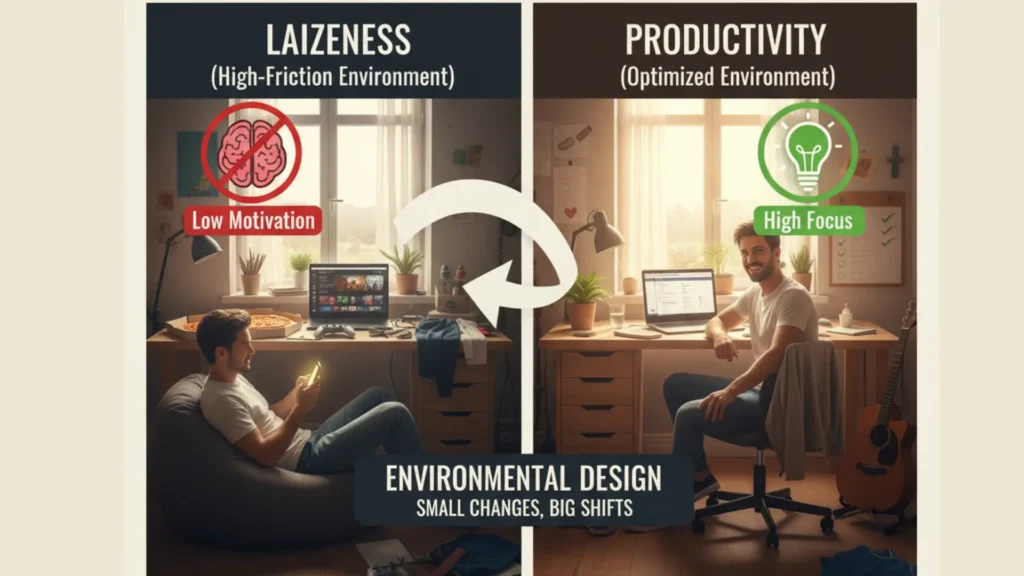
Instead of relying on willpower, design your environment so that distraction takes effort.
- Move distracting apps into hidden folders or use “app locks” during study time.
- Log out after each session so the next impulsive check requires an extra step.
- Keep only study-related bookmarks visible on your browser.
These subtle constraints, known as neuro-adaptive habits, work with your psychology instead of against it. When focus becomes the path of least resistance, consistency follows naturally.
This isn’t punishment it’s an intelligent design for attention.
Reclaiming Mental Energy Through the Detox Loop
When you apply the Audit–Anchor–Automate loop, you’re not just managing distractions you’re retraining your neural pathways. Over a few weeks, your mind begins to prefer stillness, your attention span stretches naturally, and your motivation revives.
That’s cognitive restoration in motion: the brain recovering its capacity for sustained, meaningful effort.
Soon, students who once struggled to study without music or scrolling start experiencing a new kind of focus calm, uninterrupted, and deeply satisfying.
Because true digital detox isn’t about distance from devices it’s about reclaiming ownership of your mind.
Minimalist Tech Habits That Boost Academic Flow

Once you understand how attention works, digital minimalism stops being a concept it becomes a lifestyle. The goal isn’t just to spend less time online; it’s to build a mental environment where focus feels natural, and learning flows without friction.
Students often believe productivity is about doing more, but true academic flow comes from doing one thing deeply and without interruption. That’s where minimalist tech habits make all the difference.
Rebuilding Your “Mental Environment” for Deep Work
Your mind reflects your environment. If your workspace is cluttered with screens, alerts, and tabs, your brain learns chaos. But if your environment is clean, intentional, and quiet, your cognition mirrors that too.
Think of digital minimalism as mental hygiene — clearing cognitive space for high-value thinking. Every choice: what you see, what you hear, what you click trains your attention patterns.
To rebuild your environment for focus, start with three pillars: space, structure, and signals.
1. Phone-Free Study Zones: Protect Your Cognitive Bubble
A phone on your desk isn’t neutral it’s a loaded stimulus. Research shows that even a silent phone within sight can reduce working memory and task engagement.
So build a phone-free study zone — a clear area where your brain knows, “Here, I think deeply.”
Practical steps:
- Keep your phone in another room or in a drawer during study sessions.
- If you need music, use a separate device (like a small MP3 player or offline playlist).
- Use focus timers like Forest or Pomofocus only if they don’t open other distractions.
This physical separation builds a neural boundary your brain associates this space with learning, not scrolling. Over time, focus becomes automatic when you sit down a powerful cognitive cue for task immersion.
2. Single-Task Study Windows: The Art of Focus Stacking
Forget multitasking it’s a myth that divides attention and drains retention. Instead, use focus stacking: aligning small blocks of deep concentration with short, intentional breaks.
For example:
- 40 minutes of single-topic focus (no tabs, no switching apps)
- 5–10 minutes of rest, reflection, or movement
- Then return for another focused block
Each “stack” strengthens your brain’s endurance for flow state that mental zone where time dissolves, effort feels easy, and learning becomes immersive.
Flow isn’t born from intensity it’s born from continuity. Every time you single-task with intention, you’re teaching your brain that focus is rewarding.
3. Meaningful Notification Filters: Design Attention, Don’t Defend It
You don’t need to cut off the world you just need to control how it enters your space.
Set meaningful notification filters that separate what’s urgent from what’s merely available.
- Disable alerts for social media, promotional emails, and non-essential apps.
- Keep only messages from close contacts or study groups active.
- Use “scheduled notification windows” check updates at fixed times instead of constantly reacting.
This is called attention design shaping your digital environment so you decide when to engage, not your phone.
Once you stop reacting to pings, your brain can sustain deep focus long enough to achieve flow continuity, where your concentration remains stable across tasks.
4. Why Your Study Rhythm Matters More Than Study Hours
Students often chase longer study hours but your brain values rhythm over duration.
Just like muscles, mental endurance grows through consistent, rhythmic training not all-day marathons.
A minimalist study rhythm looks like this:
- Defined start and end times
- Predictable deep-work sessions
- Natural transitions between focus, reflection, and rest
This rhythm activates the ultradian performance cycle a natural 90–120 minute wave of alertness and fatigue. When you align your study windows with that biological rhythm, focus feels effortless.
Digital minimalism supports this flow by removing micro-interruptions that reset your mental state. The fewer resets your brain undergoes, the more energy remains for actual thinking the essence of sensory minimalism in learning.
From Tech Chaos to Academic Clarity
Minimalist tech habits aren’t about restriction they’re about liberation. By creating structure and simplicity, you free up the one resource every student is starved for: mental bandwidth. When your mind isn’t processing endless notifications, it begins to process ideas. When your environment stops pulling you outward, your focus turns inward where true learning lives.
That’s the quiet power of digital minimalism: not doing less, but doing better.
Beyond Discipline: Designing a Digital Identity That Supports Learning
Digital minimalism isn’t just about controlling your phone, it’s about redefining who you are when you’re not scrolling.
Many students see themselves as “always online,” constantly plugged into notifications, messages, and updates. But that identity silently shapes how you think and study. When you believe you need constant connection, your brain adapts to it and it becomes your default mode.
The real transformation begins when you shift that identity from “connected consumer” to “intentional learner.”
The Psychology of Digital Identity
Your environment doesn’t just reflect your habits it creates them.
The screens you open, the apps you use, the people you interact with all send subtle messages about who you are. If your world revolves around notifications and validation, your self-concept starts depending on external feedback.
But when your environment centers around learning, creativity, and mindful connection, your brain rewires itself for intrinsic motivation the kind of motivation that comes from purpose, not pressure.
This is the core of digital self-concept: designing your digital spaces to mirror the kind of student and person you want to be.
Reclaiming Self-Worth from Likes, Streaks, and Metrics
Every “like” and “view” feels like a small burst of approval but when your worth depends on numbers, focus becomes impossible. You start studying for appearance, not understanding. You share progress to feel visible, not accomplished.
To break that loop, practice attention ownership — deciding where your focus goes and why.
Instead of checking how others respond, notice how you respond to your own effort.
- How did that study session feel?
- What did you learn today that genuinely excited you?
- Did your focus feel aligned with your goals?
When you start measuring growth through engagement with knowledge instead of engagement metrics, learning feels meaningful again.
That’s how you rebuild confidence from the inside out not through streaks or statistics, but through personal progress.
Shifting from Online Presence to Inner Purpose
Digital minimalism is not withdrawing its alignment.
When you intentionally design your digital identity around growth and curiosity, you stop chasing connection and start creating meaning. You don’t disappear from the digital world; you appear more authentically within it.
Whether it’s choosing who to follow, what to post, or how often to engage, every choice becomes an act of self-definition.
Over time, this identity shift becomes your invisible discipline, one that sustains learning without constant effort.
Because when your digital world supports your purpose, focus isn’t something you force, it’s something that naturally follows who you’ve become.
Case Study: A Student’s 14-Day Digital Minimalism Challenge
When Sarah, a university student, realized she couldn’t study for more than ten minutes without checking her phone, she decided to try something different a 14-day digital minimalism challenge. No extreme detox, no app deletions, just small, intentional steps to reclaim her focus.
Week 1: Building Awareness and Simple Limits
In the first few days, Sarah didn’t change much. She only observed her digital behavior when she checked her phone, why she did it, and how it made her feel.
She noticed a pattern: every time she felt stuck during studying, she reached for her phone out of habit, not need. This awareness revealed her behavior loop a cycle of boredom → impulse → scroll → guilt.
By Day 4, she created two small rules:
- Screen-free mornings for the first 30 minutes after waking up.
- Notification batching checking messages only three times a day.
The results were almost immediate: her mind felt clearer, and her mornings became calmer. She described it as “finally feeling like I start the day on my own terms.”
Week 2: Adding Structure and Mindful Substitution
By the second week, Sarah replaced random screen checks with intentional actions.
When she felt distracted, she stood up, stretched, or wrote down her next task building what psychologists call attention rhythm: alternating focus and rest with purpose.
She also began setting single-task study windows 40 minutes of deep work followed by 10 minutes of physical reset.
Within days, she noticed her reading speed improved, and information seemed to stick longer a clear sign of better memory retention and cognitive recovery.
Results: Less Anxiety, More Control
At the end of 14 days, Sarah didn’t become a minimalist monk she still used her phone, scrolled social media, and replied to friends. But the difference was this: she was in control.
Her anxiety dropped, her focus sessions doubled, and her confidence grew. Most importantly, she stopped feeling guilty about using technology because now it served her, not the other way around.
This simple challenge proved a deep truth:
Digital minimalism isn’t about deleting your digital life it’s about designing it to support your real one.
The Academic Connection
By taking control of her digital habits, Sarah’s academic performance naturally improved. Her study sessions became longer, her notes more organized, and her recall during exams stronger. This connection between attention rhythm, emotional regulation, and academic performance highlights what modern learning research confirms:
“Focus isn’t just a skill it’s a state of mind shaped by your environment.”
In only two weeks, Sarah discovered that less screen time didn’t mean fewer results it meant better results with less mental noise.
Final Reflection: Tech Should Amplify, Not Replace, Your Mind
Technology isn’t the enemy. It’s a tool one that can either amplify your learning or quietly replace your mental effort. The difference lies in intention. When used mindlessly, devices become cognitive thieves, siphoning attention and energy. But when used deliberately, the same technology can extend your reach, clarify your thinking, and help you master even complex subjects.
Think of your digital world like your notebook. You don’t keep random scribbles, irrelevant notes, or outdated drafts cluttering the pages. You curate. You highlight what matters. Digital minimalism asks you to do the same: keep only what fuels your growth apps, notifications, and online habits that align with your learning goals, and remove the rest.
This isn’t about restriction or punishment. Minimalism isn’t about less it’s about more: more focus, more clarity, more freedom for your mind to explore and create. It’s about reclaiming the space in your head that constant distractions silently stole.
As you step away from the noise and begin designing your digital environment with purpose, remember: the goal isn’t perfection. It’s intentionality. Every choice, every filter, every small habit you implement compounds, creating a brain trained for focus, flow, and meaningful learning.
Technology should be your ally, not your crutch. Minimalism isn’t about what you give up it’s about what you gain: the freedom to think, learn, and grow without distraction.
So start small, stay consistent, and remember: your mind is the most valuable tool you’ll ever own. Treat it with care, and everything else even the digital world can follow.