
Last updated: October 2025
Table of Contents
The Role of Physical Exercise in Academic Performance
The Silent Variable in Grades Nobody Talks About
Why Exercise Improves Study Motivation
Cardio vs. Strength: Which Type of Exercise Helps the Brain More?
The 3-Hour Window Rule: When to Work Out for Maximum Learning
How Exercise Protects Against Academic Fatigue
The Role of Physical Exercise in Academic Performance: What Science Says

The Silent Variable in Grades Nobody Talks About
Most students believe success depends on study hours, perfect notes, or natural talent but there’s a hidden factor silently influencing every grade: physical movement.
Before it sculpts your body, exercise rewires your brain. When you move even for 15 minutes your body increases oxygen flow, glucose transport, and neurotransmitter release. These aren’t just fitness perks; they directly sharpen executive function, the brain system behind focus, planning, and memory.
Yet many still believe, “Exercise steals study time.”
Science says the opposite. Regular movement extends your mental stamina, improves fatigue regulation, and keeps your energy consistent throughout the day.
Imagine two students with identical study routines. One sits all day, the other walks for 20 minutes before studying and stretches during breaks. After a few weeks, the difference becomes obvious the active student remembers more, stays alert longer, and performs better under pressure.
Exercise doesn’t just train muscles it fuels cognition. True academic endurance isn’t just about effort or intelligence; it’s built on how you treat your body.
From Muscles to Memory: The Biology Behind Sharper Thinking
When your body moves, your brain pays attention. Aerobic activities like running, cycling, or brisk walking don’t just burn calories they reshape the brain for learning.
Movement boosts blood flow to areas that manage memory and attention. This oxygenation strengthens communication between neurons, improving synaptic efficiency how fast your brain processes and stores new information.
The real magic lies in BDNF (Brain-Derived Neurotrophic Factor) often called fertilizer for the brain. Exercise triggers BDNF production, helping new brain cells grow and improving connections in the hippocampus, the region critical for learning and long-term memory.
MRI studies reveal that students who exercise regularly have denser gray matter in brain regions tied to decision-making, focus, and emotional regulation. So, every time you work out, you’re literally reinforcing the circuits responsible for success in school.
Your textbooks train your knowledge but your sneakers train your neurons. Each workout becomes an investment in sharper memory, faster recall, and mental clarity that lasts long after your heart rate returns to normal.
The Dopamine Equation: Why Exercise Improves Study Motivation

If motivation were a formula, dopamine would be the missing variable.
This neurotransmitter drives pleasure, reward, and goal pursuit the spark that makes studying feel fulfilling instead of forced. But constant stress, poor sleep, and excessive screen time flatten dopamine levels, leaving you mentally drained.
Exercise restores that balance. A short jog, a few stretches, or even dancing in your room triggers the release of dopamine, serotonin, and endorphins your brain’s natural motivation cocktail.
Exercise and the “Flow Effect”
Right after a workout, your mind enters a heightened focus state known as flow where time fades, distractions disappear, and deep work feels effortless. That’s not a coincidence; post-exercise dopamine stabilizes mood and primes attention networks.
That’s why many students say, “I think better after I move.” They’re not imagining it their brain is literally recharged for productivity.
Micro-Activity, Macro Motivation
The secret isn’t marathon workouts it’s micro-movement.
Take stairs instead of elevators, walk while revising flashcards, stretch every 60 minutes. These small actions keep your dopamine loop active all day, making effort feel easier.
In short: Exercise teaches your brain to enjoy effort again.
Motivation stops being something you wait for it becomes something you build.
Cardio vs. Strength: Which Type of Exercise Helps the Brain More?

Students often ask, “What’s better for studying running or lifting?”
Both help, but in unique ways. The winner isn’t the workout type, it’s consistency.
Cardio: The Oxygen Advantage
Cardio (walking, cycling, swimming) improves aerobic fitness, increasing oxygen and nutrient delivery to the brain.
Oxygen is brain fuel that keeps neurons firing cleanly, improving concentration and retention.
A 20-minute brisk walk can sharpen recall within weeks. Think of it as a mental warm-up: cardio gets your brain into study mode before you even open your notebook.
Strength Training: The Discipline Builder
Strength workouts (weights, resistance bands, bodyweight exercises) enhance emotional regulation and mental grit. They lower cortisol, the stress hormone that kills focus, while boosting testosterone and growth hormone, linked to confidence and persistence.
Every rep you push trains your willpower the same muscle that helps you finish essays and handle academic pressure.
Consistency Beats Category
Neuroscience confirms that moderate, regular movement outperforms intense, inconsistent workouts.
You don’t need a gym. Walk daily, cycle to class, do pushups between lectures your brain doesn’t care how fancy the routine is. It rewards regularity.
Bottom line:
- Cardio fuels focus.
- Strength builds discipline.
- Consistency transforms both into academic power.
The 3-Hour Window Rule: When to Work Out for Maximum Learning
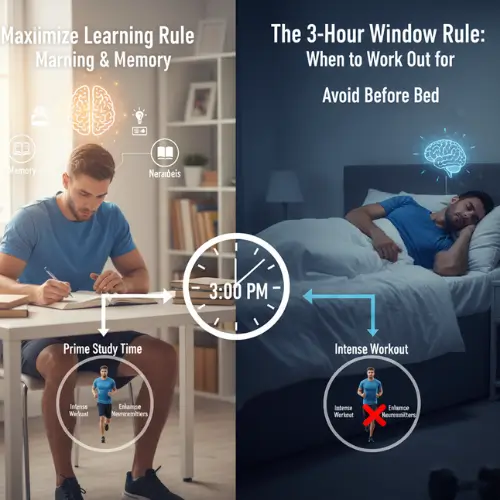
It’s not just what you do, but when. The timing of your workout can shape how well you retain information and stay focused.
Why Timing Matters
Your body runs on a 24-hour circadian rhythm that governs energy peaks, alertness, and hormone cycles. Exercise acts like a reset button for this rhythm syncing your body and brain to perform at their best.
When you move within three hours of your most focused study time, you naturally enter a sharper mental state. This principle known as the 3-Hour Window Rule — optimizes both productivity and memory retention.
Workout Timing Guide for Students
Finding the right workout time isn’t about discipline it’s about brain chemistry. Each time slot affects focus, mood, and memory differently. Here’s how to choose the best one for your learning rhythm:
| Workout Timing | Best For | Brain Benefit | Example Activity |
|---|---|---|---|
| Morning (Within 3 Hours of Waking) | Students who struggle with low energy or procrastination | Boosts alertness, regulates cortisol | Light jog, yoga, quick stretch |
| Pre-Study (Within 3 Hours Before Studying) | Afternoon or evening learners | Enhances focus and memory encoding | Brisk walk, mobility routine |
| Evening (2–3 Hours Before Sleep) | Students with stress or sleep issues | Lowers cortisol, improves melatonin release | Calm walk, stretching, light yoga |
Morning Movement — The Focus Foundation
Morning exercise aligns your energy with daylight, boosting executive function your brain’s ability to plan, decide, and learn effectively. Students who start their day with movement experience longer-lasting focus and emotional balance.
Pre-Study Workouts — The Focus Booster
Working out before study sessions floods your brain with oxygen and dopamine. Even 10 minutes of movement helps fight fatigue and sharpen attention for complex tasks.
Evening Exercise — The Calm Reset
Gentle evening workouts help regulate sleep hormones and improve recovery. Just avoid heavy lifting late at night can delay rest.
Find Your Focus Curve
Track your energy peaks for a week. Pair light exercise with study times that match your natural rhythm.
When movement syncs with your biology, studying feels smoother, and memory sticks longer.
Key Takeaway:
“Move your body within three hours of your most focused study time and your brain will remember more, focus longer, and sleep deeper.”
Burnout Buffer: How Exercise Protects Against Academic Fatigue
Constant sitting raises cortisol the stress hormone that quietly drains your mental energy. Exercise acts as a reset mechanism, flushing stress chemicals and restoring balance to your nervous system.
Even a 10-minute body reset a walk, a few squats, or a stretch can re-engage your parasympathetic system, calming your body and restarting your learning capacity mid-day.
Think of movement as an antidote to academic burnout: a quick recharge for your brain’s energy circuits that keeps motivation sustainable over long semesters.
Exercise and Sleep: The Twin Engines of Academic Focus
No amount of caffeine can replace the power of good sleep combined with regular exercise. Together, they form a performance loop: movement improves sleep quality, and quality sleep boosts learning capacity.
During REM sleep, your brain consolidates new knowledge. Students who move regularly fall asleep faster, stay in deep sleep longer, and store memories more effectively.
Building a rhythm of circadian alignment, movement, and rest is what transforms short-term motivation into long-term performance.
The “Movement Strategy” for Modern Students
A realistic 3-step plan any student can follow:
- Micro-Movement Integration — Add short bursts of motion during breaks. (Stretch between pages or walk while memorizing notes.)
- Habit Stacking — Pair exercise with existing routines (e.g., revise flashcards after a walk).
- Track Energy, Not Minutes — Forget gym obsession; note when you feel most alert and align workouts with that rhythm.
Within two weeks, many students notice increased focus spans, steadier energy, and less anxiety.
From Body to Belief: How Exercise Builds Academic Identity
Students who stay active often develop a stronger sense of self-efficacy the belief that effort leads to growth.
Each workout reinforces a mindset: “If I can push through one more rep, I can solve one more problem.”
This embodied confidence transfers from the gym to the classroom, turning discipline into identity.
When your physical habits reflect resilience, your academic behavior naturally mirrors it. You start seeing yourself not just as a student but as someone built for progress.
Final Reflection: Study Hard, Move Smart
Academic success isn’t purely mental it’s bio-behavioral.
Your body is the hardware that runs your learning software.
Exercise doesn’t compete with studying; it completes it.
Try the 14-day challenge: move for at least 20 minutes daily and note your focus, sleep, and mood changes.
You’ll notice studying stops feeling like a battle, and starts feeling like a flow.
Because in the end, smart students don’t just study harder.
They move smarter.

Written by Usama Kaleem
Usama is the founder of InspireStudents.com a platform built to help students boost motivation, focus, and productivity through science-based habits. He’s passionate about mindset, growth, and helping others reach their academic goals.
Related Articles And Topics











Unlock 150 motivational quotes for students to beat laziness, stay focused, and build confidence. Perfect inspiration for exams, studies, and daily success ,..readmore..

