Table of Contents
How to Turn Laziness Into Productivity by Restructuring
Introduction: Laziness Isn’t the Enemy — Environment Is
The Science Behind Laziness and Environment
Designing a “Productivity-Friendly” Physical Space
Restructuring Your Digital Environment
Habit Triggers & Environmental Cues
Social and Emotional Environment
How to Turn Laziness Into Productivity by Restructuring Your Daily Environment
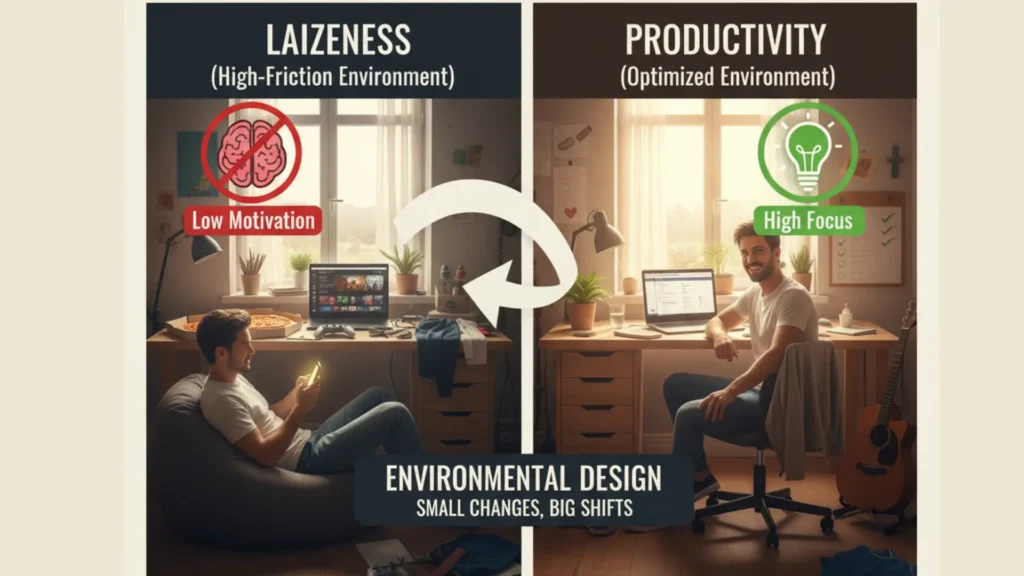
Introduction: Laziness Isn’t the Enemy — Environment Is
When I first started struggling with my studies, I used to label myself as “lazy.” I’d sit at a cluttered desk with half-opened notebooks scattered everywhere, my phone buzzing nonstop with notifications, and a to-do list that only made me feel more guilty than motivated. The harder I tried to push myself, the heavier I felt. It wasn’t that I didn’t care about my goals, I cared a lot. But something about my surroundings always seemed to pull me away from focus.
Over time, I realized what many students overlook: laziness is rarely about ambition. Most of us want better grades, confidence, and a future we can be proud of. The real problem is the environment. The messy desk that encourages distraction. The room where I’m studying feels like a burden. The digital spaces that quietly hijack our attention.
Once I started changing my environment, everything shifted. I didn’t have to “fight laziness” anymore; it faded on its own. A cleaner study space, fewer phone interruptions, and even simple sensory cues made productivity feel natural, almost automatic.
That’s what this article is about: showing you how small environmental tweaks in where you live, study, and rest can turn “I don’t feel like it” into “I’m already doing it.” By the end, you’ll see why your environment is often more powerful than willpower itself.
The Science Behind Laziness and Environment
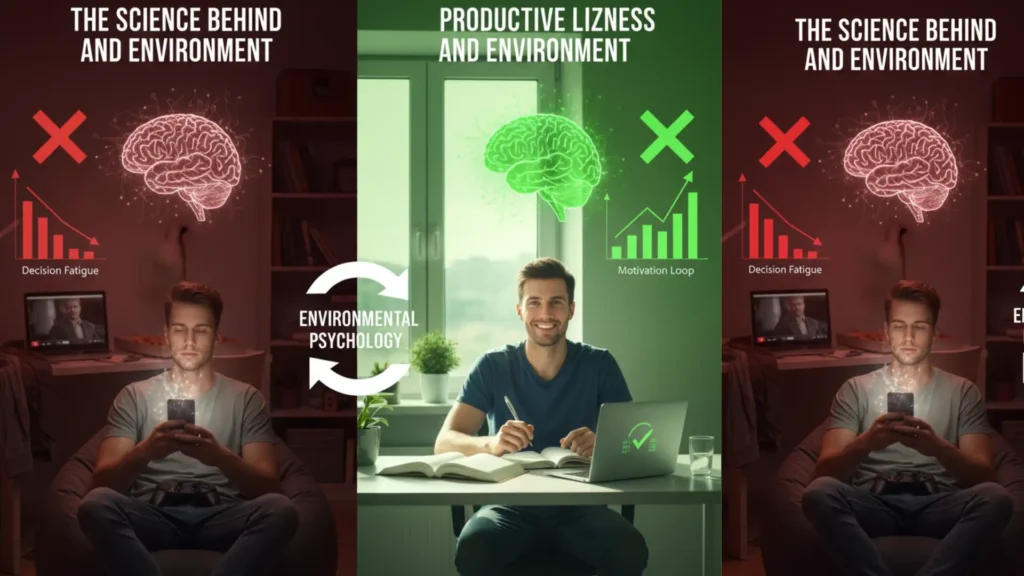
Most students blame themselves when they can’t sit down and focus, thinking they’re lazy or unmotivated. But science tells a different story: the problem isn’t your willpower—it’s the environment silently shaping your behavior.
Why Willpower Fails
Relying only on willpower is like trying to hold your breath underwater. You can push for a short while, but eventually, you give in. Psychologists call this decision fatigue: the more choices your brain has to make in a day, the weaker your self-control becomes. By the time you sit at your desk after classes, even deciding whether to open your notes or scroll through TikTok feels exhausting.
On top of that, modern technology is designed to hijack dopamine, the brain chemical linked to motivation and reward. Social media, notifications, and endless entertainment train your brain to chase instant hits of pleasure instead of long-term focus. Pair that with a messy desk or cluttered room, and your brain enters cognitive overload you feel drained before you even start.
The Hidden Power of Environmental Cues
Here’s what most people underestimate: your surroundings constantly give your brain signals about what to do. Light, sound, even smell—all of these act as silent nudges.
- Lighting that’s dim makes you sleepy; bright, natural light tells your brain it’s time to focus.
- Noise in the background raises stress, while a calm environment lowers mental resistance to work.
- Layout matters too: a laptop facing your bed is an unconscious reminder to relax, while a clean desk with only a notebook and pen invites you to start writing.
These cues work below the level of awareness, which is why even the most motivated students struggle if their environment is fighting against them.
Research-Backed Insight
Studies consistently show that productivity isn’t about pushing harder, it’s about removing resistance. Researchers at Stanford and Harvard highlight a simple principle: when the friction for distractions is high, and the friction for studying is low, productivity rises automatically. For example, keeping your phone in another room increases the “effort” needed to get distracted, while keeping your notebook open on your desk lowers the effort to start studying.
In other words, productivity is less about discipline and more about design. The brain naturally follows the path of least resistance your job is to make sure that path leads to focus, not distraction.
Designing a “Productivity-Friendly” Physical Space
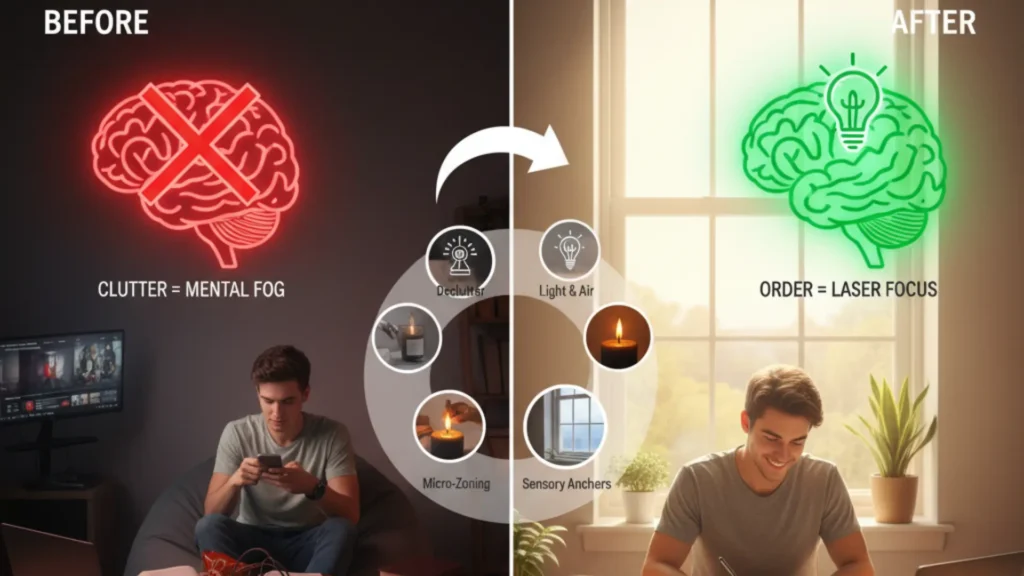
When students think about improving grades, they often focus on study techniques or motivation hacks. But here’s a hidden truth: the space around you plays just as big a role in shaping how much you actually get done. A poorly structured study space silently drains focus, while a carefully designed one makes concentration feel almost automatic.
Declutter = Mental Clarity
A cluttered desk isn’t just an eyesore, it’s a silent productivity killer. Research in cognitive psychology shows that visual clutter competes for your brain’s attention, creating micro-distractions that increase stress and slow decision-making. That’s why you might sit down with the intention of studying but suddenly notice a snack wrapper, a random notebook, or yesterday’s laundry, and your focus slips away.
On the flip side, a minimal desk setup with just your notebook, pen, and one open textbook signals to your brain exactly what the priority is. Every item on the desk is either helping or hurting your ability to concentrate. The fewer irrelevant objects, the clearer your mental bandwidth.
Quick fix: Before starting any study session, spend two minutes clearing your desk. Think of it as a “reset button” for your brain
Lighting & Air Flow Matter More Than You Think
Most students underestimate how much the environmental basics of light and air directly impact focus.
- Natural light boosts alertness by regulating circadian rhythms, keeping your body’s internal clock in sync. Studying near a window during the day can make you more awake and motivated without extra caffeine.
- Poor air circulation leads to fatigue and even mild headaches. A stuffy room lowers oxygen intake, making your brain feel sluggish. Simple actions like opening a window or using a small desk fan can sharpen concentration in ways you’ll notice almost instantly.
If you can’t access natural light, consider using a daylight lamp during study hours. Small changes in brightness and airflow can create an environment that supports your brain rather than drains it.
The Micro-Zoning Trick
Here’s a powerful yet underused strategy: micro-zoning. Instead of treating your whole room as one catch-all space, divide it into specific zones for specific tasks.
- A corner or desk for studying.
- A separate chair or spot for relaxation.
- If possible, a small area for reading or brainstorming.
By doing this, you create location-based cues. When you sit at your desk, your brain associates that space with focus. When you move to your relaxation zone, your brain knows it’s time to rest. This separation reduces the constant “battle” of trying to focus in the same spot where you scroll, nap, and eat.
Even if you’re in a small dorm room, the trick works: shift a chair’s direction, place a small mat, or change lighting to mark a zone. It’s less about size and more about giving each activity its own anchor in space.
Sensory Anchors: A Fresh Approach
Most productivity guides stop at “clean your desk.” But here’s a next-level hack that very few talk about: using sensory anchors to train your brain into focus mode. Think about it your brain forms strong associations with sensory input. The smell of coffee makes you feel awake, a favorite song can bring back old memories. You can deliberately use this mechanism to trigger concentration on demand.
- Scent: Light the same mild-scented candle (like lavender or citrus) or use a specific essential oil only when studying. Over time, your brain will connect that smell with “focus mode.”
- Sound: Create a consistent background sound like low-volume instrumental music, white noise, or even a particular playlist that you only use during study sessions. Eventually, pressing play on that track becomes the mental equivalent of flipping a switch.
- Touch: Even a small ritual like holding the same pen or slipping on “study-only” headphones can serve as a subtle signal to your brain.
These sensory anchors act like shortcuts for attention. Instead of wrestling with motivation, you condition your brain to respond automatically.
Restructuring Your Digital Environment
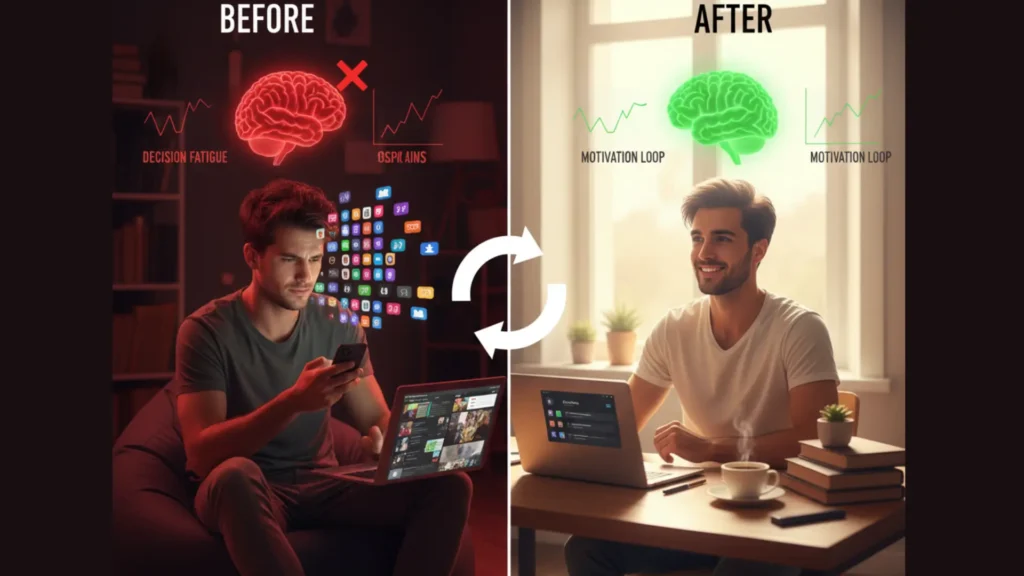
If your physical desk sets the stage for focus, your digital space often determines whether you’ll actually get through your tasks or get lost in endless scrolling. For students today, distractions don’t just sit on the desk; they live inside the screen. Notifications, tabs, and apps are carefully designed to capture your attention, not help you succeed. Restructuring your digital environment is like redesigning your room: it reduces friction for learning and increases resistance to distraction.
App Friction Design: Making Distractions Harder to Access
Here’s a powerful principle from behavioral science: if something is harder to access, you’ll do it less often. Most students keep Instagram, TikTok, or YouTube front and center on their home screen. That single swipe is all it takes to fall into a 30-minute black hole.
Instead, move distracting apps off your home screen or bury them in a folder several swipes away. You can even install app lockers that require an extra step like a passcode or time delay before opening social media. That tiny layer of friction breaks the autopilot habit loop.
Example: Imagine wanting to check TikTok but needing three swipes and a passcode. By the time you reach the app, your brain has a moment to reconsider: Do I really need this right now?
The Single-Tab Rule: Digital Clutter = Mental Clutter
Just as a messy desk scatters focus, too many browser tabs scatter mental energy. When you’ve got 12 open at once notes, YouTube, WhatsApp Web, Gmail you’re essentially multitasking, even if you think you’re studying. The single-tab rule is simple: keep only the tab related to your current task open. If you need multiple resources, use a read-later tool or digital notebook to save them. This reduces “switching cost,” the cognitive energy wasted when your brain constantly toggles between tasks. Students who try this often find they complete tasks faster, with less stress, simply because their attention isn’t being fragmented across a digital jungle.
Digital Minimalism for Students: Protecting Mental Energy
One of the most overlooked truths of productivity is this: every notification costs energy. Even if you don’t respond, the buzz, banner, or red dot steals a slice of your focus. Psychologists call this “attention residue” . Your brain lingers on the notification even after you’ve dismissed it.
The solution is digital minimalism reducing unnecessary inputs so your brain can fully engage with the important ones.
- Turn off non-essential notifications (do you really need to know when someone liked your meme?).
- Group communication apps and check them at set times instead of reacting instantly.
Create “study-only” folders with apps you need for learning (dictionary, flashcard apps, PDF reader) so your phone becomes a tool, not a trap.
A Real Student Example
Consider Sara, a university sophomore who used to spend hours scrolling without realizing it. She restructured her phone in two simple ways:
- Turned on grayscale mode, making her screen dull and less stimulating.
- Created a study-only home screen with apps like Notion, Quizlet, and a timer.
The result? Her screen time dropped by 40% within a week, and she reported feeling “less pulled” by her phone during study sessions. The best part was she didn’t quit social media altogether; she just put it in its place.
Habit Triggers & Environmental Cues

One of the most powerful ways to defeat procrastination is to stop relying on raw motivation and instead let your environment do the work for you. In psychology, habits are built on “cues” the small signals that tell your brain what to do next. If you redesign these cues, you’ll find that productivity flows almost automatically.
Cue Reshaping: Turn Your Environment Into a Reminder
Think of your brain as a pattern-recognition machine. When it sees the same object in the same context, it prepares for the same action. That’s why simply placing a notebook on your desk at night can prime your brain to write first thing in the morning. The cue is subtle, but over time it creates an automatic response: notebook = time to study.
Other examples students can try:
- Keep flashcards next to your water bottle so reviewing becomes part of staying hydrated.
- Leave a pen on top of your planner so your first instinct is to jot down tasks instead of opening your phone.
These are not just reminders, they’re preloaded signals that shift your brain into the right gear before you even realize it.
Micro-Barriers: Making Laziness Harder
If cues make good habits easier, then micro-barriers make distractions harder. Laziness often survives because the path to procrastination is frictionless you don’t even think before grabbing your phone or opening YouTube.
Restructure your environment so that every distraction takes effort:
- Keep your phone in another room when studying so reaching for it feels like a decision, not a reflex.
- Remove social media shortcuts from your browser, so opening them requires typing the full address.
- Store the TV remote in a drawer, not the couch, so watching becomes a choice instead of a background habit.
The idea is simple: the harder it is to be lazy, the more likely your brain chooses focus instead.
Implementation Intention Environments
This is a next-level strategy borrowed from behavioral psychology: tie a specific space to a specific action. Instead of vague goals like “I’ll study more,” create if-then rules linked to places.
For example:
- When I sit in this chair, I only do flashcards.
- When I open this desk drawer, I always take out my reading list.
- When I go to the library’s second floor, I only work on assignments.
By assigning environments to tasks, you reduce decision fatigue and train your brain through repetition. Over time, just sitting in the right spot activates the right mental state with no willpower required.
Social and Emotional Environment

Productivity isn’t just shaped by your desk, your apps, or your room, it’s also influenced by the people and emotions surrounding you. A well-structured social and emotional environment acts like invisible scaffolding: it holds you steady when willpower feels shaky and gives you momentum when energy runs low.
Accountability Spaces: Breaking the Isolation Trap
Studying alone can feel heavy, and isolation often fuels procrastination. This is why accountability spaces work so well. They create gentle social pressure to stay on task:
- Study groups where everyone commits to showing up with their notes.
- Co-working spaces where the energy of focused people rubs off on you.
- Virtual study rooms (like Discord or Zoom focus groups) where you log in, announce your task, and quietly work alongside others.
When you know someone else is also working or even just watching it’s harder to slip into laziness. Accountability doesn’t need to be strict; it just needs to remind you that you’re not carrying your academic journey alone.
Positive Peer Pressure: The Company You Keep
There’s a saying: “You become the average of the five people you spend the most time with.” When it comes to productivity, this couldn’t be more true. Surrounding yourself with peers who normalize studying, setting goals, and celebrating small wins naturally shifts your behavior.
For example, if your friends casually review notes before class, you’ll likely join in. But if your group laughs off assignments until the last minute, you’ll absorb that pattern too. Positive peer pressure isn’t about competition it’s about being in an environment where focus feels natural and procrastination feels odd.
Quick tip: Even one “study buddy” who checks in daily can act as a strong productivity anchor.
Emotional Cues: Nudging Motivation from Within
While social surroundings matter, your personal emotional space is equally powerful. The brain thrives on visual and emotional cues that remind it of purpose.
- Vision boards with images of your future goals (like graduation, career paths, or personal dreams) act as constant reminders of why your work matters.
- Sticky notes with micro-goals (“Finish 1 page of notes,” “Review 5 flashcards”) reduce overwhelm by breaking work into visible, doable chunks.
- Inspirational quotes or affirmations placed near your desk can create a micro-burst of motivation when your energy dips.
These cues don’t magically erase hard work, but they create a positive emotional climate, a mindset where effort feels connected to hope and progress rather than just pressure.
Resetting When You Fall Back Into Laziness
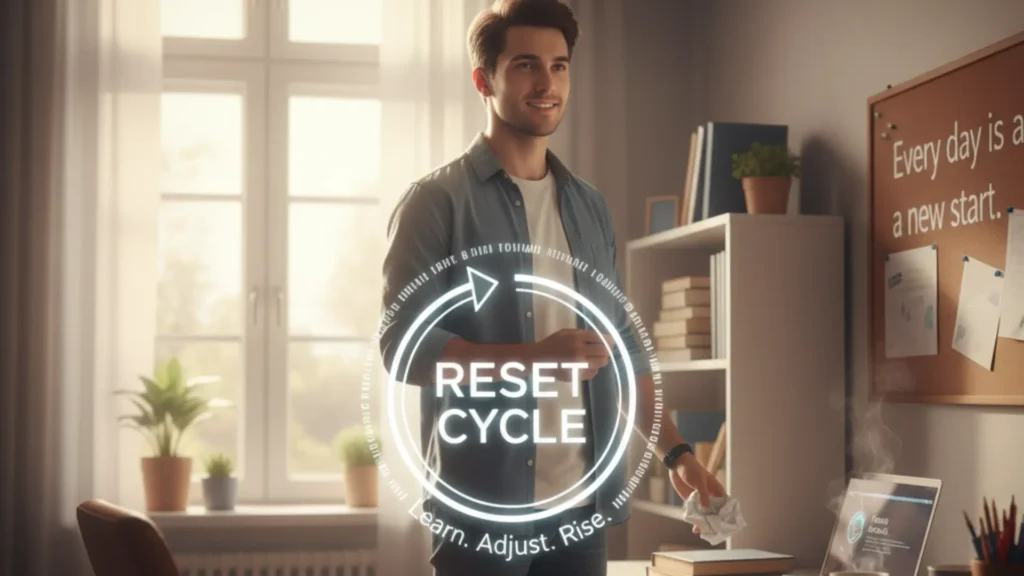
Even with the best systems, there will be days when laziness sneaks back in. Maybe your desk is messy again, your phone pulls you into endless scrolling, or your mind feels too tired to focus. The truth is: falling off track isn’t failure it’s part of the process. What matters is how quickly you reset.
The “Reset Environment” Routine
Think of your environment like a browser that sometimes freezes. Instead of panicking, you simply refresh the page. In the same way, you can refresh your study environment with a simple 5-minute reset routine:
- Clear your desk: Put away scattered papers, empty cups, or snacks that clutter your view.
- Light a candle or open a window: A sensory change signals to your brain that you’re starting fresh.
- Take a deep breath: Even 30 seconds of intentional breathing resets stress and helps you step back into focus.
From my own experience, this small ritual has saved me countless times. On days when I felt like giving up, just tidying my desk and resetting the atmosphere shifted my mindset from “I’m lazy” to “I’m ready again.”
Micro-Wins: The Antidote to Overwhelm
One big mistake students make is believing productivity only “counts” if it’s hours long. In reality, progress begins with micro-wins.
- Five minutes of reading is better than zero.
- Writing two sentences builds momentum for a full page later.
- Reviewing a handful of flashcards can restart a full study session.
When you frame productivity this way, “starting small” no longer feels like failure it feels like strategy.
Preventing the Spiral of Laziness
What often turns one lazy moment into a full lazy day is the spiral effect: your desk stays messy, you avoid your tasks, guilt builds, and you check out completely. But environmental resets act like a brake on that downward spiral. They remind you:
- Laziness isn’t a permanent state, it’s just a signal that your environment needs a quick tune-up.
- Productivity can restart in minutes, not hours.
By focusing on resets instead of perfection, you take back control. Instead of waiting for motivation to magically return, you use your environment as the switch that brings you back on track.
Conclusion: Productivity Isn’t About Force, It’s About Design
Most students think productivity means forcing themselves to work harder, but the truth is the opposite: real success comes from fewer decisions, smarter surroundings, and environments that protect your energy. When your space, tools, and habits are designed well, productivity doesn’t feel like a battle, it feels natural. Here’s your next step: choose just one environmental tweak today. It could be as simple as moving your phone out of reach, cleaning your desk, or adding one small positive trigger like a sticky note with a goal. These micro-changes add up faster than you expect.
Remember this: “Your environment is either pushing you toward laziness or pulling you toward success. The choice is in how you design it.”