How to Study for Exams in One Week: Day-by-Day Plan That Works
Last updated: May 2026
This guide works best for students with 5–7 days before a single exam or overlapping exam session. It does NOT address long-term revision strategies or open-book assessments.
Studying for exams in one week means building a structured 7-day schedule, prioritising weak topics, switching to active recall over re-reading, and using spaced repetition tools to lock in knowledge before exam day.
That’s the short answer. Here’s why it matters: according to Kahoot!’s Study Habits Snapshot 2024, 47% of students cite time management as their top study challenge — and over 40% have skipped an exam entirely due to anxiety or lack of preparation. One week isn’t ideal. But used right, it’s enough.
Why Your Current Approach Probably Isn't Working
Look — if you’re reading this at 11pm with your exam a week away, you’ve likely already tried re-reading notes twice, highlighting everything in yellow, and watching a few YouTube explainers that felt productive at the time.
Here’s the thing: none of that is studying. That’s recognition, not recall. Your brain can recognise something it’s seen before without being able to reproduce it under exam pressure. Re-reading creates the illusion of learning. It feels familiar, so it feels known — but familiarity and actual retrieval ability are completely different skills.
Research published in CBE—Life Sciences Education found that the number of active study strategies a student used — not how early they started — was the strongest predictor of exam performance. Students who started studying earlier but relied on passive methods didn’t outperform those who started later and studied actively.
Start earlier. It’s still the right advice. But if you can’t, start smarter.
The 7-Day Study Plan: What to Do Each Day
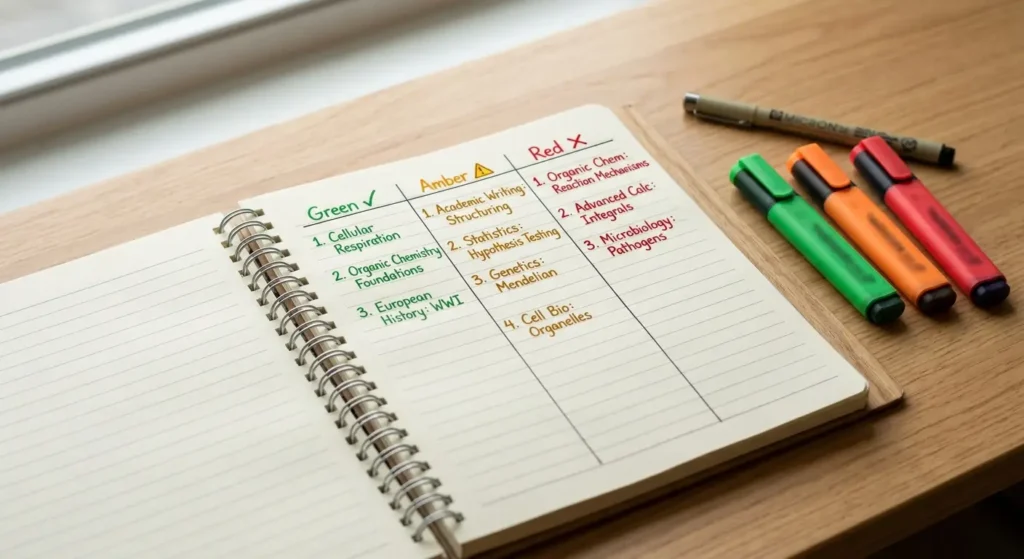
Before the schedule kicks in, spend 20 minutes on one thing: get your exam specification, mark every topic on it, and rate each one Green (solid), Amber (shaky), or Red (barely touched). This colour-code becomes your whole week’s decision engine.
Day 1 — Audit Everything, Plan Nothing Else
Don’t open a single textbook to study today. That sounds counterintuitive. Do it anyway.
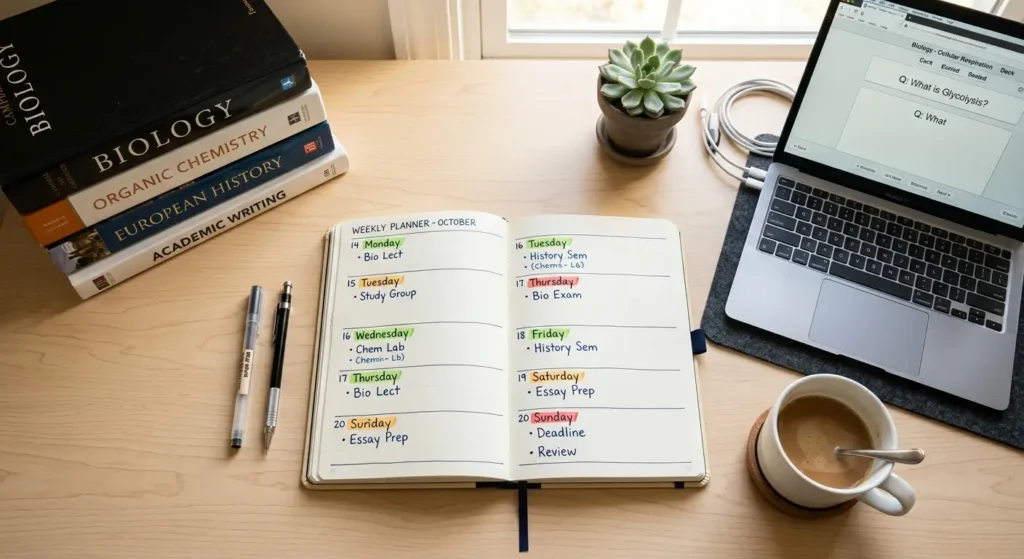
Your only job on Day 1: know exactly what the exam covers, what you know, and what you don’t. Use that Red/Amber/Green list. Then open Google Calendar or Notion and build a session-by-session schedule for Days 2–7.
Be specific. Not “study biology.” Write “Tuesday 10am–12pm: Cell respiration (Red) — first read, then blurt.” The difference between a vague plan and a specific one is the difference between doing it and not doing it.
Also do this today:
Confirm exam date, time, location, and permitted materials
Gather every resource: slides, textbooks, past papers, reading lists
Count your available study sessions — realistically, including meals, sleep, and other commitments
Quick note: Red topics get 3 sessions. Amber get 2. Green get 1 brief review plus practice. If you have more Red topics than your schedule allows, you need to triage further — pick the highest-exam-weight topics first.
Day 2 — First Pass on Your Worst Topics
Today is the last day passive reading is allowed. After this, every session is active output only.
Work through your top 2–3 Red topics. Read each one for 30–40 minutes, then close your notes and write a summary from memory. Don’t check until you’re done writing. Those gaps you notice? That’s the actual learning — not the reading.
Create basic flashcards or cue questions in Anki as you go. You’ll review them on a spaced schedule from Day 3 onward. Don’t spend more than 3 hours studying today. Burning out on Day 2 derails the rest of the week.
Day 3 — Active Recall Starts Now
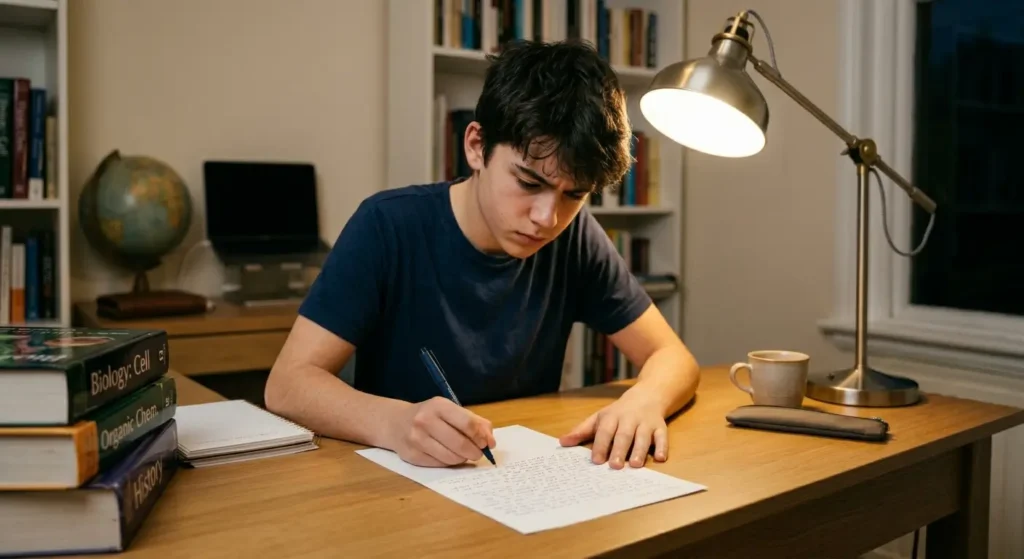
No more reading without producing. Today’s method for everything:
Blank page — write everything you know about the topic
Check your notes — identify the gaps
Read ONLY the gaps
Blank page again — write it again
This is called blurting. It’s not comfortable. That discomfort is the learning happening.
In the afternoon, tackle your Amber topics using the same method. Add new Anki cards as you go. By the end of Day 3, you should have a full retrieval question set covering every major topic.
If there are concepts you still can’t explain after two attempts, try this: explain it aloud in plain language, as if to a friend who knows nothing about the subject. The moment you stumble is the exact thing to go back and re-read — just that, nothing else.
Day 4 — Past Papers, No Excuses
This is the single most valuable day of the week
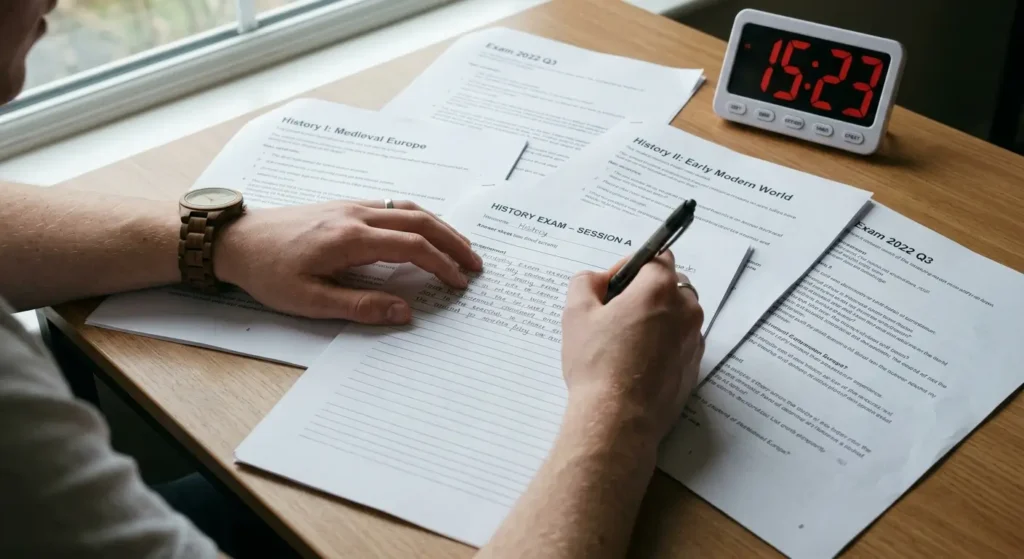
Attempt at least one full past paper under exam conditions: timed, no notes, no phone, sitting at a desk. Not an outline — actual full answers, even rough ones. For maths and sciences, full working shown.
Most students skip this because they “don’t feel ready yet.” That feeling never goes away. The discomfort of not knowing an answer under timed pressure is precisely the mechanism that drives retention. Don’t wait to feel ready. Attempt it uncomfortable.
After, mark it honestly. Every question you got wrong or left blank is Day 5’s work. Write them down specifically — not “revise thermodynamics” but “cannot explain the second law applied to open systems.
Quick comparison: active vs passive study
| Method | What it feels like | Actual retention |
| Re-reading notes | Easy, familiar | Low — recognition only |
| Highlighting | Productive | Very low — visual only |
| Watching lectures again | Comfortable | Low — passive input |
| Blurting / recall | Uncomfortable | High |
| Past papers timed | Stressful | Very high |
| Anki spaced repetition | Effortful | High over time |
| Teaching aloud | Awkward | Very high |
Day 5 — Targeted Gap Repair Only
Do not review everything today. That’s a trap.
Go back only to the specific gaps identified in yesterday’s past paper attempt. Treat each one as a surgical fix: re-read only the relevant section, blurt it back, test yourself on that single point. Move to the next gap.
Group study works well today — not for social reasons, but because explaining a concept to someone else exposes exactly where your understanding breaks down. If you can explain the second law of thermodynamics to a friend without checking your notes, you know it.
This is also a good day to ask your lecturer or tutor about anything you’ve attempted and still don’t understand. Most will help. Most students never ask.
Day 6 — Consolidate, Then Actually Stop
Morning: condense everything into one-page topic summaries — key definitions, formulas, frameworks, anything that needs to be memorised. Flashcards, mind maps, whatever format suits you. Keep them brief.
Afternoon: do one final past paper or a targeted question set on your weakest remaining areas. Then stop.
I’ve seen conflicting data on this — some sources argue that studying right up until the night before increases performance through final consolidation, while others suggest diminishing returns hit hard after 6 hours of cumulative revision on a single day. My read is that the consolidation day matters most for students who are anxiety-prone: stopping early gives the brain time to process and reduces the cortisol spike that tanks working memory on exam day.
Give yourself a real evening off. Cinema, box set, food you enjoy, a walk. This isn’t laziness — it’s biology. Sleep that night matters more than any additional hour of study.
Day 7 (Exam Day Eve or Morning) — Light Review Only
Review your one-page summaries and flashcard deck. See what you can recall without looking. That’s it.
Do not attempt new material. Do not re-read entire chapters. If you encounter something you can’t remember, accept it, note it, move on.
Eat properly. Drink water. Sleep as close to your normal time as possible. Lay out everything you need the night before: ID, pens, permitted materials, whatever the exam requires. The exam-morning logistics should require zero thought.
Or maybe I should say it this way: the goal of Day 7 isn’t to learn more. It’s to arrive at the exam with a calm, functional brain. That’s a preparation decision, not a study one.
What to Do If You Have Multiple Exams This Week
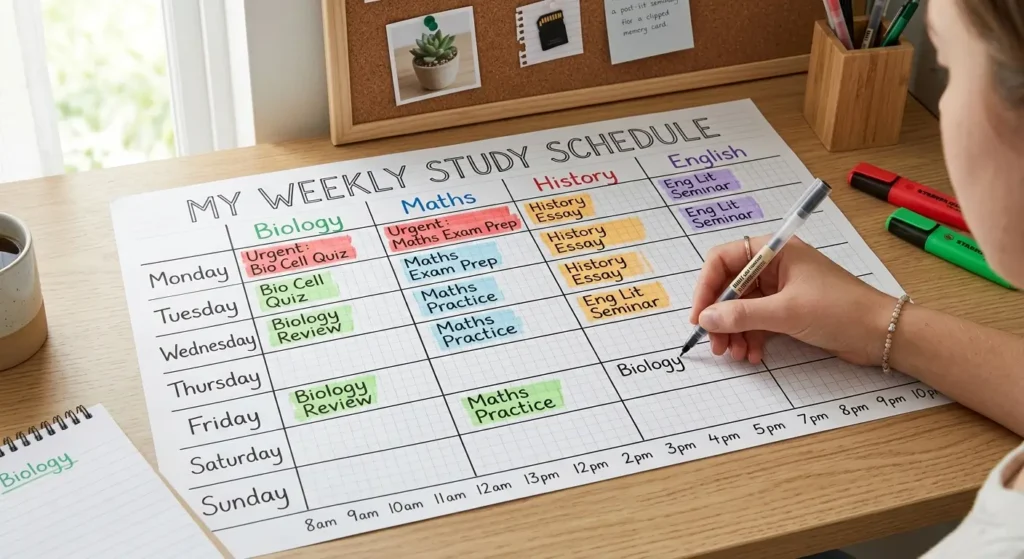
Neither of the top-ranking articles on this topic addresses this — but it’s the actual situation most university students face.
The principle changes slightly. You don’t run a separate 7-day plan per exam. You interleave them using a tiered priority system:
Exam within 3 days: That exam gets morning sessions (peak cognitive hours) and past paper priority. Active recall only.
Exam in 4–7 days: That exam gets afternoon sessions for Day 1–3 foundation work. No past papers yet — that comes when it moves into the 3-day window.
Exam in 7+ days: Minimal attention right now. One 30-minute session to audit and colour-code topics so you know where you stand. Nothing more.
The biggest mistake with multiple exams is treating every exam as equally urgent. They’re not. Sequence matters.
The Tools That Actually Help (And One That Doesn't)
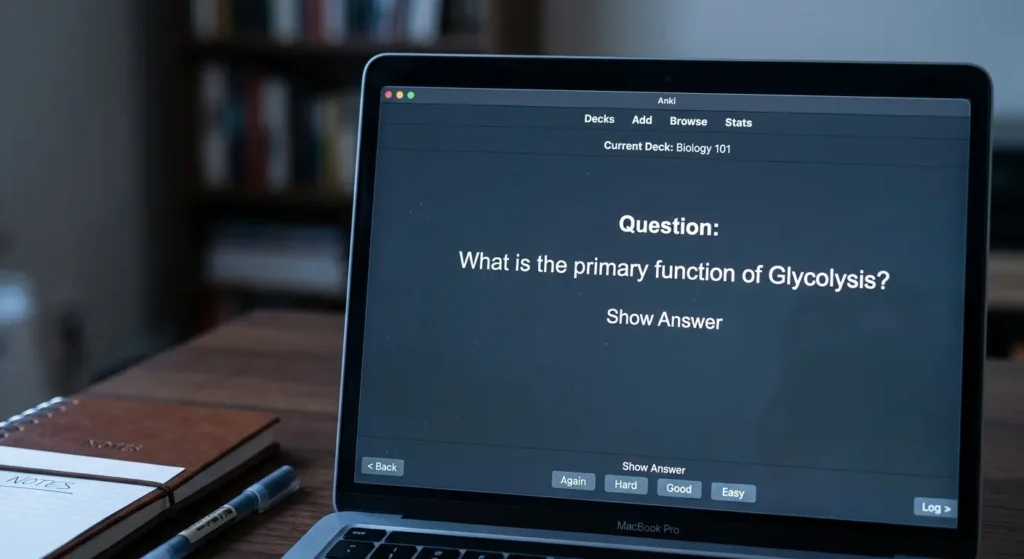
Anki — spaced repetition flashcard app. Free on desktop. The algorithm decides when to show you each card based on how well you recalled it last time. This is the only tool where passive use still produces active learning, because the system forces retrieval on a schedule. Set it up on Day 2 and keep adding cards through Day 5.
Notion or Google Calendar — use either for your session-by-session schedule. The specific tool doesn’t matter. What matters is that every study session has a topic, a method, and a time block assigned before the day starts. Vague plans don’t survive contact with the morning.
YouTube explainers — useful on Day 2 for Red topics you genuinely cannot understand from text alone. After that, put it away. Watching is passive. You should be producing, not consuming.
Some experts argue that mind maps are highly effective for revision. That’s valid for visual learners doing initial comprehension. But if you’re using mind maps at Day 5 instead of past papers, you’re still in input mode when you should be in output mode. The distinction matters.
The Exam Morning Routine Nobody Talks About
Most articles stop before exam day. This matters.
Wake up with enough time to eat — not rush. Protein and complex carbs outperform skipping breakfast, which tanks working memory within an hour. Don’t review new material. Skim your one-page summaries if it calms you, not to learn but to prime recall.
Arrive at the venue with 10–15 minutes to spare. Use that time to breathe, not to cramm.
When you sit down: read every question before you answer any. Allocate your time before you start writing. The students who run out of time on exams almost always spend disproportionate time on an early question they felt confident about.
Q&A — Questions People Actually Ask Out Loud
Q: What's the best way to study for an exam in 7 days?
A: Prioritise topics by exam weight and personal weakness, switch to active recall (blurting and past papers) from Day 2, use Anki for spaced repetition, and protect sleep throughout. Seven days is enough if you stop re-reading.
Q: How many hours a day should I study when an exam is a week away?
A: Four to six hours of focused active study beats eight hours of passive review. Diminishing returns hit hard after six hours. Use Pomodoro blocks — 45 minutes study, 10-minute break — and stop entirely by 9pm the night before.
Q: Should I study the night before an exam?
A: Light review only — flashcard summaries and one-page notes. No new material, no past papers, no long sessions. Sleep matters more than any additional study hour at this stage.
Q: Why does re-reading feel productive but not work?
A: Re-reading creates familiarity, which the brain misreads as mastery. You can recognise something without being able to retrieve it under pressure. Retrieval practice — writing from memory before checking — is what builds actual exam performance.
Q: When should I start using past papers?
A: Day 4 at the latest, even if you feel underprepared. The discomfort of not knowing an answer under timed conditions is what drives retention. Waiting until you “feel ready” means you’ll never start.